What Is EPR? A Complete Guide to Extended Producer Responsibility in India

Every product a business sells eventually reaches the end of its life. A phone stops charging. A television screen cracks. A batch of unsold inventory is written off. For most businesses, the responsibility for a product used to end at the point of sale. That assumption no longer holds. Under Indian environmental law, producers, importers, and brand owners now carry responsibility that extends well past the checkout counter, into how their products are collected, recycled, and disposed of once customers are done with them. This is the idea behind Extended Producer Responsibility, or EPR. So, what is EPR? In simple terms, EPR is a regulatory framework that makes producers of certain goods, most notably electrical and electronic equipment, responsible for ensuring their products are collected and recycled in an environmentally sound way after they become waste, rather than leaving that burden entirely on municipalities, consumers, or the environment. For any business that manufactures, imports, or sells electronics in India, understanding EPR isn't optional background reading. It's a compliance requirement with real operational and legal consequences.
What Is EPR?
Extended Producer Responsibility is a policy approach that shifts part of the responsibility for a product's end-of-life management back onto the entity that placed it on the market, typically the producer, manufacturer, importer, or brand owner.
Traditionally, once a product was sold, the manufacturer's obligations were considered complete. EPR changes that by connecting the sale of a product to what happens to it later: collection when it becomes waste, transportation to appropriate facilities, recycling or material recovery, and reporting on how much was actually processed.
Governments use EPR frameworks for a straightforward reason. Producers are best positioned to influence how a product is designed, what materials go into it, and how it can eventually be recycled. By making producers accountable for end-of-life outcomes, EPR creates an incentive to design better products and build functioning collection and recycling systems, rather than leaving electronic waste to accumulate in landfills or informal scrap markets.
In India, EPR is not a single generic rule. It applies through specific regulations for different waste streams, including plastic packaging, batteries, tyres, and, most relevant here, electrical and electronic equipment (EEE) under the E-Waste (Management) Rules.
How Does Extended Producer Responsibility Work?
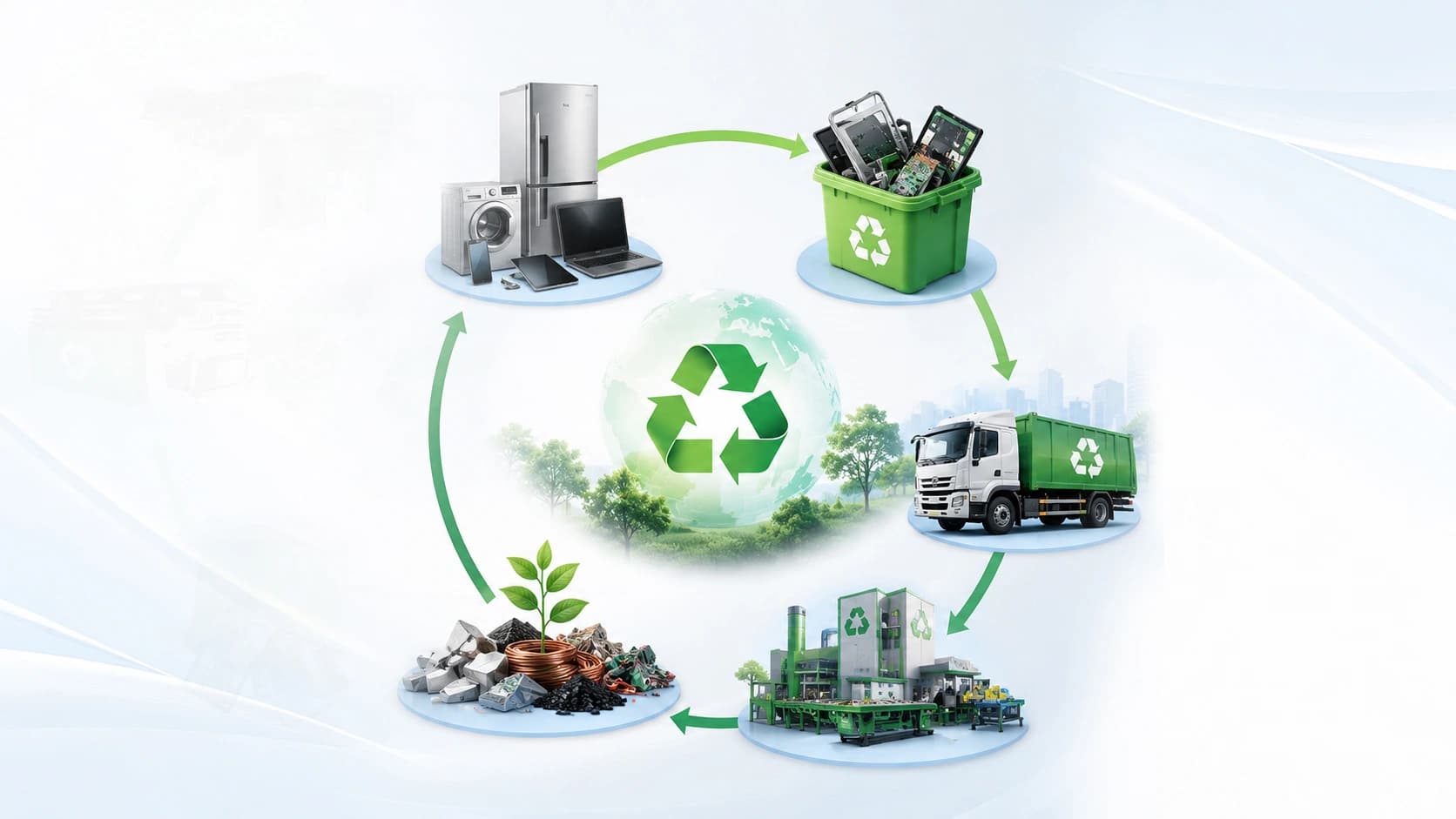
At a conceptual level, EPR follows a defined lifecycle that connects a product's sale to its eventual recycling. Understanding this flow makes the rest of the compliance picture much easier to follow.
The basic lifecycle looks like this: a product is placed on the market, it's used until it reaches the end of its functional life, it's collected or taken back, it's transported to an authorized facility, it's recycled or recovered for materials, and the entire process is documented and reported to the regulator.
| Stage | What Happens | Why It Matters |
|---|---|---|
| Product placed on market | Producer manufactures, imports, or sells electrical/electronic equipment | Establishes the producer's obligation under EPR from the point of sale onward |
| End of life | Product is no longer usable or is discarded by the consumer | Triggers the need for structured collection rather than informal disposal |
| Collection / take-back | Product is collected through drop-off points, take-back schemes, or bulk consumer channels | Ensures e-waste enters the formal system instead of landfills or unregulated scrap dealers |
| Transportation / channelization | Collected e-waste is transported to registered recyclers or dismantlers | Prevents leakage into unauthorized or unsafe processing |
| Recycling / recovery | Materials such as metals, plastics, and glass are extracted through authorized recycling | Recovers value and reduces environmental harm from hazardous components |
| Documentation / reporting | Producers and recyclers record and report quantities processed | Provides regulators and producers with verifiable evidence of compliance |
| Compliance | Recycling targets are checked against obligations for the period | Determines whether the producer has met its EPR obligations under the applicable rules |
Each of these stages is interdependent. A producer can't demonstrate compliance without documentation, and documentation is only meaningful if the underlying collection and recycling actually happened through legitimate, registered channels.
What Is EPR in Waste Management?
Zooming out from electronics specifically, what is EPR in waste management more broadly? It's a policy mechanism that redistributes responsibility for post-consumer waste away from being purely a public or municipal problem, and partly onto the businesses that generated the waste in the first place through the products they sold.
In conventional waste management, once a product left a factory or store, the burden of dealing with it as waste fell largely on municipal systems, informal waste pickers, or the environment itself. EPR reframes this relationship. Producers, importers, and brand owners are now expected to fund or organize collection and recycling systems for the waste generated by their own products.
This connects directly to several broader themes in environmental policy:
- Waste generation is tied back to the producer who created the product, not treated as an anonymous downstream problem.
- Collection systems are built with defined roles for producers, recyclers, and sometimes retailers.
- Recycling and resource recovery become measurable obligations rather than voluntary good practice.
- Circular economy principles are reinforced, since materials recovered through EPR-driven recycling can re-enter manufacturing supply chains instead of being permanently lost.
- Environmental compliance shifts from a purely reactive, penalty-driven model to one built around ongoing producer accountability.
EPR is one of the clearer examples of how environmental regulation and business operations increasingly intersect, particularly for companies operating at scale.
What Is EPR in E-Waste Management?
Electrical and electronic equipment is one of the sectors where EPR is most developed and most strictly enforced in India, managed under the E-Waste (Management) Rules, 2022, which came into force from April 2023 and superseded the earlier E-Waste (Management) Rules, 2016.
Under the current framework, EPR in e-waste management centers on a few core elements:
End-of-life electronics. The rules cover electrical and electronic equipment listed in the applicable schedule, along with their components, consumables, parts, and spares.
Collection and channelization. Producers are expected to establish or participate in systems that ensure end-of-life products are collected and directed to registered recyclers, rather than informal or unregistered operators.
Registered recycling. A defining feature of the current rules is that manufacturers, producers, refurbishers, and recyclers are required to register on a centralized CPCB portal, rather than the older state-level authorization model used previously. Recycling must happen only through recyclers registered under this system.
Recycling targets and obligations. Producers are assigned recycling targets tied to the equipment categories they place on the market, which they must meet, generally through registered recyclers.
EPR certificates. The current rules introduced a certificate-based mechanism: registered recyclers can issue EPR recycling certificates for the e-waste they process, and producers can use these certificates to demonstrate that their recycling obligations have been met.
Reporting and record keeping. Registered entities are expected to maintain records and report e-waste handled through the system, supporting traceability across the collection-to-recycling chain.
Environmentally sound management. Underlying all of this is the core objective of the rules: ensuring e-waste is processed in a way that protects human health and the environment, rather than through unsafe informal recycling practices such as open burning or acid leaching.
It's worth noting explicitly that the regulatory framework has evolved. The 2016 rules relied on a system of "EPR Authorisation" granted by State Pollution Control Boards. The 2022 rules replaced this with online registration on a CPCB-administered portal, along with a revised definition of EPR itself, tied more directly to measurable recycling targets. Businesses researching EPR obligations should be careful not to rely on older descriptions of the authorization process, since the mechanics have changed materially.
Who Needs EPR Registration in India?
Not every business needs EPR registration, and it isn't accurate to say every company selling any product falls under this framework. Applicability depends on the specific waste stream and the applicable rules governing it.
For electrical and electronic equipment specifically, EPR registration in India generally becomes relevant for:
- Producers who manufacture electrical or electronic equipment covered under the applicable schedule
- Importers who bring covered EEE into India for sale
- Brand owners who sell electronic products under their own brand, even if manufacturing is outsourced
- Manufacturers producing covered equipment domestically
- Refurbishers and recyclers, who have their own separate registration requirements under the same framework
There are also categories of businesses, such as certain importers dealing exclusively in equipment or components not listed under the covered schedule, that may fall outside EPR obligations. Because applicability depends on the exact product category, business model, and current rules, it's worth treating "do we need EPR registration" as a question that requires a specific assessment rather than a general assumption either way.
So is EPR mandatory for electronics businesses? For businesses that fall within the categories covered under the E-Waste (Management) Rules, yes, compliance isn't optional. But since applicability hinges on the specific products and business activities involved, it's worth confirming your position directly rather than assuming either way.
What Is EPR Registration?
EPR registration is the formal process through which an obligated business is recognized by the regulator, currently CPCB for e-waste, as a producer, manufacturer, refurbisher, or recycler operating under the EPR framework.
In practical terms, the registration process generally involves:
- Determining applicability — confirming whether the business's products fall under the covered equipment categories.
- Identifying the product category — mapping products to the correct classification under the applicable schedule, since obligations and targets can vary by category.
- Preparing business and product information — details such as company information, product categories sold, and quantities placed on the market.
- Compiling required documentation — typically including incorporation and identity documents, product-related information, and other supporting material as specified by the current portal requirements.
- Submitting the registration application — through the applicable online CPCB portal for e-waste EPR registration.
- Meeting post-registration obligations — once registered, the business takes on ongoing responsibilities, including working toward recycling targets, maintaining records, and reporting.
Because the exact document checklist, portal workflow, and processing timelines are periodically updated by CPCB, businesses should treat the registration process as something to verify against current official guidance at the time of application, rather than relying on static instructions found in older articles.
A common question at this stage is what documents are actually required for EPR registration. In general, this includes business identity and incorporation details, product and category information, and data on quantities placed on the market, but the exact checklist should always be confirmed against current CPCB portal requirements at the time of application, since it has been revised before and can change again.
What Is EPR Authorization for E-Waste?
This is a point of common confusion, partly because terminology has shifted alongside the regulatory framework itself.
Under the earlier E-Waste (Management) Rules, 2016, businesses were required to obtain "EPR Authorisation" from the relevant State Pollution Control Board. This was a state-level approval process tied to a producer's collection and recycling plan.
Under the current E-Waste (Management) Rules, 2022, this state-level authorization model has been replaced by centralized registration on a CPCB portal. The regulatory concept of EPR itself has also been redefined, now tied explicitly to meeting recycling targets through registered recyclers, with compliance evidenced through the EPR certificate mechanism described earlier.
In current usage, "EPR authorization for e-waste" is often used informally to refer to this registration and compliance status under the 2022 rules, even though the formal authorization process from the 2016 rules has been superseded. Businesses should understand that EPR registration, ongoing EPR obligations (including recycling targets), and demonstrated compliance (through certificates and reporting) are now distinct but connected parts of a single system, rather than one static "authorization" document.
What Are the Main EPR Compliance Responsibilities?
Once a business is registered under the applicable EPR framework, compliance becomes an ongoing operational responsibility rather than a one-time task. Core responsibilities typically include:
- Completing and maintaining valid registration under the applicable framework
- Understanding which recycling targets and obligations apply to the specific product categories sold
- Establishing or participating in collection mechanisms for end-of-life products
- Directing collected e-waste only to registered recyclers or authorized channels
- Maintaining accurate records of quantities placed on the market and quantities recycled
- Preparing and retaining supporting documentation for audits or regulatory review
- Submitting periodic or annual reports as required under the applicable rules
- Monitoring changes to obligations, targets, or portal requirements over time
- Responding promptly to regulatory queries, inspections, or compliance notices
Because obligations can change with regulatory updates, ongoing monitoring is as important as the initial registration step itself.
Why Is EPR Important for Businesses?
It's tempting to view EPR purely as a compliance checkbox, but treating it that way undersells its practical value.
Regulatory compliance is the obvious starting point, avoiding the operational disruption that comes with non-compliance. But EPR also supports:
Responsible waste management. Structured collection and recycling systems reduce the volume of e-waste that ends up in landfills or informal, unsafe recycling operations.
Reduced environmental impact. Proper recycling limits the release of hazardous substances like lead, mercury, and cadmium into soil and water.
Traceability. Documentation and reporting requirements create a verifiable record of what happened to a product after sale, which matters increasingly to regulators, partners, and customers alike.
Recycling and resource recovery. Materials recovered through compliant recycling, including metals like gold, silver, and copper, can be reintroduced into manufacturing, reducing dependence on virgin raw materials.
Circular economy alignment. EPR compliance is one of the more concrete ways a business can participate in circular economy practices rather than simply stating support for them.
ESG and sustainability objectives. For businesses reporting on environmental performance, demonstrable EPR compliance provides tangible evidence to support sustainability claims.
Brand credibility. Increasingly, business customers, investors, and consumers view environmental compliance as a baseline expectation rather than a differentiator, which makes non-compliance a reputational risk.
Reduced compliance risk. Proactive compliance management reduces the likelihood of last-minute scrambles when obligations or reporting deadlines change.
What Happens If a Business Does Not Meet Its EPR Obligations?
Under the E-Waste (Management) Rules, 2022 and associated guidelines, CPCB has the authority to take action against registered entities that fail to meet their obligations. This can include the imposition of Environmental Compensation for non-compliance, in line with guidelines issued under the applicable rules.
Beyond financial consequences, non-compliance can also affect a business's registration status, create legal exposure under environmental protection law, and disrupt operations if regulatory issues affect a company's ability to continue selling covered products smoothly.
The specific consequences, thresholds, and procedures involved are set out in the applicable rules and associated CPCB guidelines, and they are subject to change. Businesses should treat any claims about exact penalty amounts or timelines with caution unless sourced directly from current official CPCB or Ministry of Environment, Forest and Climate Change documentation, since these details are updated periodically.
Why Do Businesses Use EPR Consulting Services?
Given how much of EPR compliance depends on correctly interpreting applicability, maintaining accurate documentation, and keeping pace with regulatory updates, it's understandable that many businesses choose not to manage this entirely in-house.
This is where EPR consulting services typically come in. Businesses commonly seek external support for:
- Applicability assessment — determining whether and how EPR obligations apply to their specific products
- Documentation — preparing the business and product information required for registration
- Registration support — navigating the application process on the applicable CPCB portal
- Compliance planning — understanding recycling targets and building a realistic plan to meet them
- Collection and channelization — setting up or connecting to functioning take-back and collection systems
- Recycling coordination — working with registered recyclers to ensure collected e-waste is processed correctly
- Reporting — preparing and submitting required documentation on an ongoing basis
- Regulatory updates — staying current as rules, targets, or portal requirements change
For businesses without dedicated environmental compliance teams, this kind of support reduces the risk of errors that could affect registration status or create avoidable regulatory exposure.
What Does an Extended Producer Responsibility Consultation Include?
A structured extended producer responsibility consultation typically works through a business's compliance picture in stages, rather than treating registration as an isolated task.
- Compliance assessment — reviewing the business's products and operations to determine which EPR obligations apply.
- Product/category assessment — mapping specific products to the correct equipment categories under the applicable schedule.
- Documentation review — checking that available business and product information meets what's required for registration.
- Registration support — assisting with the preparation and submission of the registration application.
- Compliance planning — establishing a realistic approach to meeting recycling targets over time.
- Recycling/channelization coordination — connecting the business to registered recyclers and appropriate collection mechanisms.
- Reporting and record maintenance — setting up processes to track and document compliance on an ongoing basis.
- Ongoing compliance support — monitoring for regulatory changes and adjusting the compliance approach accordingly.
The value of a proper consultation isn't just getting registered. It's building a compliance process that continues to hold up as obligations, targets, or portal requirements evolve.
What Is an Extended Producer Responsibility Support Service?
It's worth distinguishing between a one-time registration engagement and an extended producer responsibility support service, which is typically structured as ongoing, rather than a single project.
Ongoing EPR support commonly includes:
- Maintaining documentation as product lines or business details change
- Tracking compliance status against recycling targets over time
- Coordinating recycling volumes with registered recycling partners
- Preparing and submitting periodic or annual reports
- Maintaining records in a format ready for regulatory review or audit
- Monitoring regulatory updates that could affect existing obligations
- Preparing the business for potential inspections or compliance checks
For businesses with continuous product sales, EPR compliance isn't a task that's completed once. It's a recurring operational requirement, which is why many businesses prefer ongoing support over a one-time registration engagement.
How Can Bharat Recycling Help With EPR Compliance?
Bharat Recycling Pvt. Ltd. is a CPCB-authorized e-waste recycling company that provides EPR consultation and extended producer responsibility support services for producers, importers, brand owners, and manufacturers operating in India.
Bharat Recycling's EPR services are structured around the practical stages of compliance covered throughout this article, including:
- Assistance with EPR registration and documentation
- Compliance planning aligned to applicable recycling targets
- Collection and take-back mechanism development
- Reverse logistics and channelization to authorized recycling facilities
- Coordination with registered recycling operations
- Record maintenance and reporting support, including annual return preparation Because Bharat Recycling also operates its own e-waste recycling capabilities, including PCB recycling, battery recycling, and IT and electronic goods recycling, EPR compliance support is paired with actual recycling execution rather than documentation assistance alone.
This article is intended to help businesses understand the EPR framework, not to serve as legal advice or a guarantee of registration or approval outcomes. Actual eligibility, requirements, and processing depend on the applicable rules and CPCB's assessment of each application. If you're unsure whether EPR applies to your business or need help understanding the registration and compliance process, Bharat Recycling can help you assess your requirements and plan the next steps.
Talk to Bharat Recycling about your EPR compliance requirements.
EPR Compliance Process: A Simple Step-by-Step Guide
While the exact process varies depending on the applicable EPR framework and waste stream, a general compliance process typically follows these steps:
- Determine EPR applicability for your business and product categories
- Identify the correct product or waste category under the applicable schedule
- Gather required information and documents for registration
- Complete registration and other compliance requirements through the applicable portal
- Establish collection and recycling arrangements with registered partners
- Track compliance against assigned recycling targets
- Maintain records of collection, recycling, and related activity
- Submit applicable reports or returns within required timeframes
Businesses should confirm the current version of this process against official CPCB guidance at the time of application, since procedural details are periodically updated.
Conclusion
EPR, or Extended Producer Responsibility, shifts part of the responsibility for a product's end-of-life management back onto the producers, importers, and brand owners who placed it on the market. For electrical and electronic equipment, this responsibility is formalized under the E-Waste (Management) Rules, 2022, which require registration with CPCB, adherence to recycling targets, and ongoing reporting through a certificate-based compliance system.
Understanding what EPR means, how it works, and who it applies to is the first step. Meeting these obligations on an ongoing basis, as targets, documentation requirements, and portal procedures evolve, is where most businesses need continued attention.
If you're unsure whether EPR applies to your business or need help understanding the registration and compliance process, Bharat Recycling can help you assess your requirements and plan the next steps.
Talk to Bharat Recycling about your EPR compliance requirements.