Electric Vehicles in India: The Future of Mobility or Tomorrow's Environmental Burden?
.jpg&w=64&q=75)
Legal & Compliance Head
India is moving rapidly towards electric mobility. Electric two-wheelers are becoming common on city roads, electric three-wheelers are transforming last-mile transportation, state transport undertakings are adding electric buses, and almost every major automobile manufacturer is investing in electric vehicles. The numbers confirm that this is more than a passing trend. According to Government of India data, EV penetration increased from just 0.71% of vehicle registrations in FY 2019–20 to 7.50% in FY 2024–25. India has set an ambition of achieving around 30% EV share in total vehicle sales by 2030. But there is an important question that deserves more attention: Are electric vehicles truly the sustainable future of India, or are we replacing one environmental problem with another? For the recycling and waste-management industry, the answer cannot be based only on tailpipe emissions. The complete lifecycle of an EV must be considered — from mining lithium, nickel, cobalt, copper and other materials, to battery manufacturing, electricity generation, vehicle operation, second-life applications and, finally, recycling. The EV may be the future of Indian mobility. But whether that future is sustainable will depend heavily on what India does with the battery after the vehicle reaches the end of its useful life.
India's EV Transition Is Already Underway
India's EV market has expanded significantly over the last few years. Government data shows approximately 19.68 lakh EV registrations in FY 2024–25, representing about 7.5% of total vehicle registrations during the year.
The transformation is particularly visible in electric two-wheelers and three-wheelers. Under the PM E-DRIVE Scheme alone, the Government reported that more than 22 lakh EVs had been sold by 27 January 2026, including approximately 19.19 lakh electric two-wheelers and 2.93 lakh electric three-wheelers.
The Government is supporting this transition through the PM Electric Drive Revolution in Innovative Vehicle Enhancement (PM E-DRIVE) Scheme, originally approved with an outlay of ₹10,900 crore. The programme supports demand incentives, electric buses, charging infrastructure, testing facilities and development of the domestic EV ecosystem.
This makes the direction of policy clear: India considers electrification an important part of its transportation and industrial strategy.
However, encouraging EV sales is only the first stage. A sustainable EV economy requires India to build the entire value chain.
Why EVs Could Be Extremely Important for India
1. Reduced Dependence on Imported Oil
One of the strongest arguments for EV adoption in India is not environmental — it is strategic.
India currently imports approximately 88% of its crude-oil requirements. Such high dependence exposes the country to international crude-oil prices, geopolitical conflicts, shipping disruptions and foreign-exchange pressures.
Electric vehicles allow part of India's transport-energy requirement to move from imported petroleum towards domestically generated electricity.
As India's electricity system becomes increasingly renewable, this advantage could become even greater.
2. Lower Tailpipe Pollution in Indian Cities
Battery electric vehicles have no conventional tailpipe emissions during operation.
This matters particularly in densely populated cities where petrol and diesel vehicles contribute to local air pollution. Electrification of high-utilisation vehicles such as buses, taxis, delivery vehicles, two-wheelers and three-wheelers therefore has the potential to produce significant urban benefits.
However, zero tailpipe emission does not mean zero environmental impact.
The pollution and carbon footprint associated with manufacturing the battery and generating the electricity used for charging must also be considered.
3. India's Electricity Is Becoming Greener — But Coal Still Matters
A common argument against EVs in India is:
"If an EV is charged using electricity produced from coal, how can it be called green?"
This criticism has some validity, but the picture is changing.
As of January 2026, approximately 52.3% of India's installed electricity-generation capacity was from non-fossil sources. By June 2026, India's renewable-energy capacity had reached approximately 288.58 GW.
But installed capacity and actual electricity generation are not the same thing.
Government data for FY 2025–26 indicates that non-fossil sources accounted for about 29.2% of electricity generation. More recently, coal and lignite still supplied about 69.54% of electricity from April to June 2026.
Therefore, India's EV transition and electricity transition must happen together.
An EV charged increasingly from solar, wind, hydro and other low-carbon sources becomes progressively cleaner over its operating life. An EV ecosystem dependent heavily on coal captures less of its potential climate advantage.
4. EVs Can Create a Major Recycling Industry
This is where the discussion becomes especially important for India's recycling sector.
An EV battery should not simply be viewed as hazardous end-of-life waste. It is also an urban mine.
Lithium-ion batteries may contain economically important materials such as:
- Lithium
- Nickel
- Cobalt
- Copper
- Aluminium
- Graphite
- Manganese, depending on battery chemistry
Recovering these materials creates the possibility of bringing valuable resources back into India's manufacturing economy.
NITI Aayog has specifically highlighted the importance of developing a circular battery economy because many battery raw materials are sourced internationally. Recycling recovered minerals back into cell manufacturing can help reduce India's dependence on imported critical materials.
This could transform battery recycling from a waste-disposal activity into a strategic raw-material industry.
But EVs Could Also Become a Serious Environmental Burden
The biggest mistake India could make is assuming that selling more EVs automatically means becoming more sustainable.
It does not.
If battery collection, traceability, transportation, second-life management and recycling infrastructure fail to grow alongside EV sales, India could eventually face a massive new waste stream.
1. Millions of Batteries Will Eventually Reach End of Life
Every EV battery has a finite useful life.
As millions of electric two-wheelers, three-wheelers, cars, buses and commercial vehicles enter the market, large volumes of batteries will eventually leave automotive use.
These batteries cannot simply enter the informal scrap market.
Improper dismantling, storage or processing of lithium-ion batteries can create serious environmental and occupational-safety risks. Damaged batteries may present thermal-runaway and fire hazards, while inappropriate recovery methods can create additional pollution.
Therefore, India must think about end-of-life management today rather than after the waste has already accumulated.
2. Battery Recycling Is More Complex Than Conventional E-Waste Recycling
A lithium-ion EV battery pack is very different from conventional electronic scrap.
A typical EV battery system may involve modules, cells, battery-management electronics, cooling components, aluminium and steel structures, copper connections, plastics, electrolytes and active electrode materials.
Recycling therefore requires specialised infrastructure, trained personnel, safe discharge and dismantling procedures, fire-protection systems and appropriate metallurgical recovery technology.
Depending on chemistry and process design, recovery may involve mechanical pre-processing followed by hydrometallurgical, pyrometallurgical or other specialised recovery processes.
India therefore cannot assume that every conventional scrap or e-waste facility can automatically handle EV batteries safely.
3. India's Dependence Could Shift From Oil to Critical Minerals
EV adoption can reduce petroleum dependence, but batteries create another strategic challenge.
Battery manufacturing requires minerals and processed materials whose supply chains are geographically concentrated.
If India simply imports battery cells and critical minerals without creating domestic manufacturing, mineral processing and recycling capacity, the country risks changing the nature of its import dependence rather than eliminating it.
Today the concern is imported crude oil.
Tomorrow it could be imported lithium compounds, nickel, cobalt, graphite, battery cells and associated technologies.
This is why domestic recycling should be considered part of India's critical-mineral security policy, not merely its waste-management policy.
Battery Waste Management Rules: A Critical Part of India's EV Strategy
India has already created an important regulatory framework through the Battery Waste Management Rules, 2022, subsequently amended.
The framework applies Extended Producer Responsibility (EPR) to batteries. Under the system, producers have obligations relating to batteries they introduce into the market, while registered recyclers generate EPR certificates based on eligible recycling activities.
CPCB documentation makes the basic mechanism clear: producers must meet their EPR obligations and obtain certificates corresponding to waste batteries processed through registered recyclers.
This is extremely important.
It means the environmental responsibility associated with an EV does not end when the manufacturer sells the vehicle.
In principle, responsibility must extend through the battery's lifecycle.
For India's recycling industry, this can create a formal market for collection, recycling, material recovery, compliance documentation and traceability.
Second Life Before Recycling
Not every battery removed from an EV necessarily needs to be recycled immediately.
A battery may no longer provide the performance required for automotive use but may still retain sufficient capacity for less demanding applications.
Potential second-life applications include stationary energy storage and renewable-energy integration.
NITI Aayog has also discussed the potential for used EV lithium-ion batteries to be deployed in stationary storage, provided adequate testing, safety and performance standards are established.
This suggests a more sophisticated hierarchy:
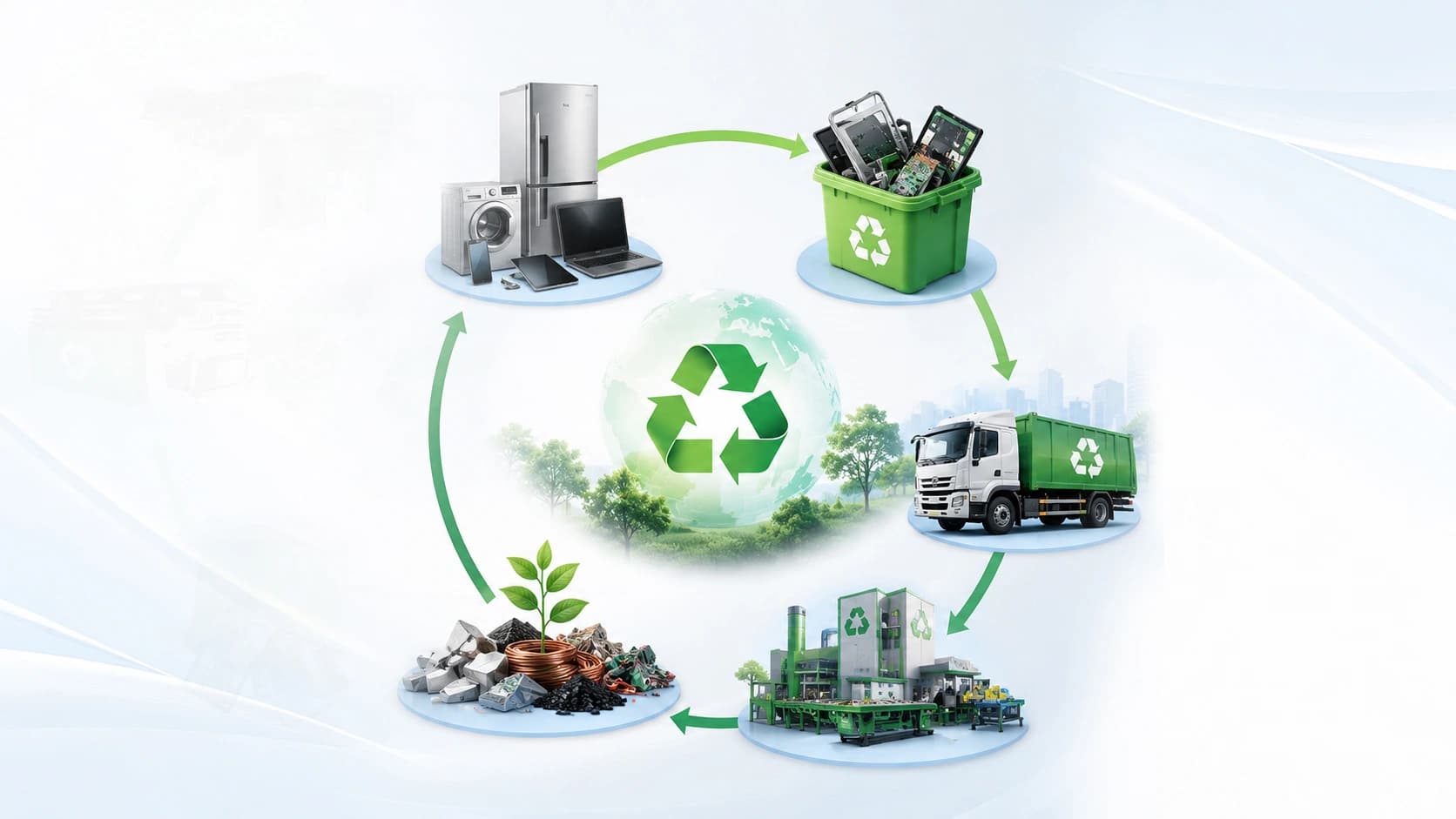
EV use → testing → suitable second-life application → final recycling → recovery of critical materials → return to manufacturing.
Such a system could extract significantly more economic value from each battery.
However, second-life applications must not become an excuse to postpone accountability. Batteries must remain traceable so that they eventually reach authorised recycling channels.
The Informal Recycling Challenge
India already has a large informal scrap economy.
It plays an important role in material collection, but EV batteries introduce risks that make uncontrolled processing particularly concerning.
If valuable battery packs move through undocumented channels, several problems may emerge: unsafe dismantling, loss of traceability, unscientific material recovery, incorrect storage, fire hazards and leakage of valuable critical minerals from the formal circular economy.
India therefore needs a system in which collection can be broad and efficient while final processing is channelled towards authorised facilities with appropriate environmental and safety infrastructure.
The success of EPR should consequently be measured not simply by the number of certificates generated but by the physical traceability and environmentally sound recycling of actual batteries.
What India Needs to Do
For EVs to become a genuine environmental and industrial success, India needs to develop several systems simultaneously.
First, battery traceability must improve. Every major EV battery should ideally remain identifiable from production or import through vehicle use, replacement, second life and final recycling.
Second, recycling capacity must expand before the major wave of EV batteries reaches end of life. Building plants after waste generation has already accelerated would be reactive policy.
Third, Recovered materials should return to domestic manufacturing wherever technically and economically feasible. Simply recycling a battery without integrating recovered lithium, nickel, cobalt, copper and other materials back into manufacturing captures only part of the circular-economy opportunity.
Fourth, EPR enforcement must remain strong. Producers, recyclers, refurbishers and other participants should operate within a transparent compliance framework.
Fifth, Battery design should increasingly consider recyclability. Standardised labelling, chemistry identification and accessible battery information can make dismantling and recovery safer and more efficient.
Sixth,Renewable electricity and EV adoption should grow together. Electrifying transport while decarbonising electricity maximises the environmental advantage of EVs.
Finally, India should view recyclers as part of the strategic EV supply chain rather than as businesses operating only at the waste-disposal stage.
EVs: Future or Burden?
The answer is: potentially both.
Electric vehicles can reduce India's oil dependence, improve urban air quality, support renewable-energy integration and create new manufacturing and recycling industries.
But they can also generate a significant battery-waste challenge, increase demand for critical minerals and create new environmental risks if collection and recycling systems fail.
The technology itself does not determine which outcome India gets.
Policy, infrastructure and circular-economy implementation will determine it.
An EV is therefore not automatically a "green vehicle" simply because it has no exhaust pipe.
The real measure of sustainability is the entire lifecycle:
- Where did the battery materials come from?
- How was the electricity generated?
- How long was the battery used?
- Was it given a safe second life?
- Where did it go after end of life?
- How much material was recovered?
- And did those recovered materials return to manufacturing?
If India can answer these questions effectively, EVs can become much more than an alternative to petrol and diesel vehicles. They can become the foundation of a domestic circular economy for batteries and critical minerals.
If India fails to answer them, today's clean-mobility revolution could become tomorrow's waste-management problem.
Conclusion
India should not ask whether it should choose EVs or recycling.
It needs both.
The country's EV transition is already moving forward. The challenge now is ensuring that recycling infrastructure, EPR enforcement, renewable power, domestic battery manufacturing and critical-material recovery move at the same speed.
For India's recycling industry, this represents a major shift.
The recycler of the future will not simply dispose of an old battery.
The recycler could become the company that supplies lithium, nickel, cobalt, copper, aluminium and other recovered resources back to India's next generation of batteries.
That is when electric mobility becomes truly circular.
And that is when EVs become not a burden, but a sustainable future for India.