Precious Metal Refining Services: Process, Gold Recovery & E-Waste Metal Recovery Guide

Electronic devices have become an essential part of modern life, powering everything from smartphones and laptops to industrial equipment and telecommunications infrastructure. What most people don't realize is that these devices also contain valuable metals — gold, silver, palladium, and platinum — hidden inside connectors, processors, and circuit boards When electronics reach the end of their useful life, this material shouldn't be treated as ordinary waste. Professional precious metal refining services exist to recover these resources safely and efficiently, extracting valuable metals from electronic waste, industrial scrap, and manufacturing by-products before they're lost to landfill. This recovery work plays a growing role in the circular economy. Instead of relying solely on new mining to meet demand for gold, silver, and other precious metals, refining allows materials already in circulation to be recovered, purified, and returned to the supply chain — reducing environmental impact while conserving finite natural resources. In this guide, we'll walk through what precious metal refining services actually involve, how the refining process works step by step, how gold and silver are specifically recovered from e-waste, and what to look for when choosing a precious metal refining company.
What Are Precious Metal Refining Services?
Precious metal refining services cover the extraction, separation, and purification of valuable metals from raw or recycled materials, bringing them up to the purity levels required for industrial, commercial, or manufacturing use.
These services typically process a wide range of input materials, including:
- Electronic waste (e-waste)
- Printed circuit boards (PCBs)
- Industrial scrap
- Precious metal catalysts
- Manufacturing residues
- Jewellery scrap
- Telecommunications and computing equipment
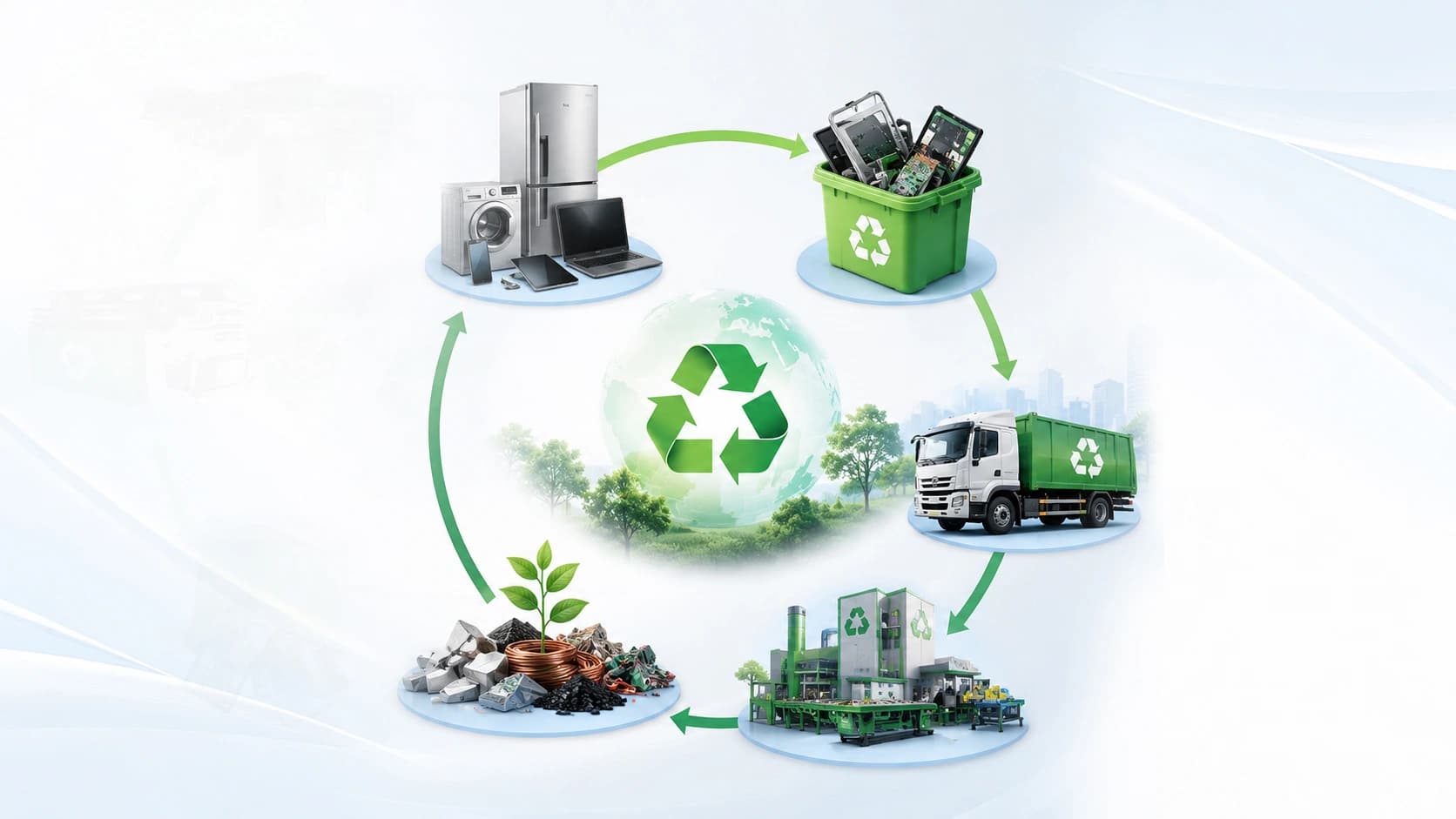
A large part of this work today falls under what's known as urban mining — recovering valuable materials from products that have already been manufactured and used, rather than extracting new ore from the ground. Urban mining is often faster, less land-intensive, and less environmentally disruptive than traditional mining, which is a big part of why refining services have become so central to sustainable resource management.
Why Are Precious Metal Refining Services Important?
Electronic waste is one of the richest — and most overlooked — sources of recoverable precious metal in the world today. A single printed circuit board contains only trace amounts of gold, silver, and palladium, but processed at scale, that recovery becomes both economically and environmentally significant.
Precious metal refining services matter for several reasons:
Resource conservation. Recovering metal from existing products reduces pressure on finite natural reserves and lowers the energy and land use associated with new mining.
Reduced mining dependency. As demand for gold, silver, palladium, and platinum continues to grow across electronics, automotive, and renewable energy industries, refined recovered metal offers a lower-impact alternative to newly mined material.
Sustainable manufacturing. Recovered metals are reintroduced into manufacturing supply chains for electronics, automotive components, medical devices, and renewable energy technologies, reducing reliance on virgin raw material.
E-waste reduction. Millions of tonnes of electronic waste are generated globally each year. Directing that waste toward refining rather than landfill keeps valuable material in circulation and reduces environmental pollution from improperly discarded electronics.
Together, these benefits are what make precious metal refining a core part of circular economy strategy, not just a waste management afterthought.
Precious Metals Recovered Through Refining
Professional refining and precious metal recovery services typically recover the following metals:
| Metal | Common Sources | Applications |
|---|---|---|
| Gold | PCBs, connectors, processors | Electronics, telecommunications, aerospace |
| Silver | Switches, solar panels, circuit boards | Industrial applications, photovoltaics, batteries |
| Palladium | Capacitors, automotive components | Electronics & automotive manufacturing |
| Platinum | Catalysts, industrial equipment | Manufacturing, medical & laboratory equipment |
Copper, while not a precious metal, is also commonly recovered alongside these materials and adds meaningful value to the overall recovery process — improving resource efficiency and reducing the need for primary copper mining.
Understanding the Precious Metal Refining Process
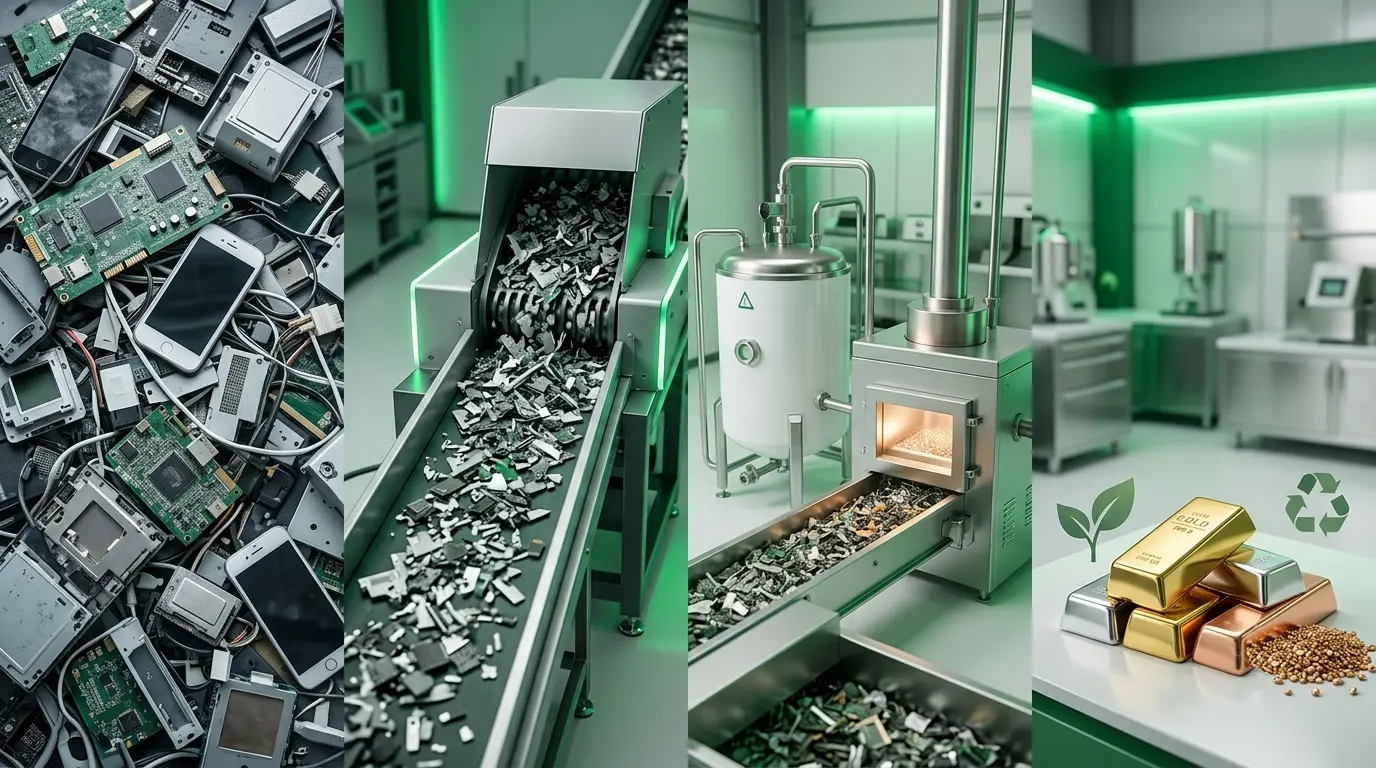
The precious metal refining process is a controlled, multi-stage industrial procedure. While exact methods vary by refiner and input material, most refining follows six key steps.
1. Collection & Material Assessment
Materials containing recoverable precious metals — PCBs, CPUs, RAM modules, mobile phones, servers, networking equipment, and industrial scrap — are collected and assessed for composition and recovery potential. This typically involves sampling and assaying to estimate metal content before processing begins.
2. Sorting & Dismantling
Incoming material is sorted by type, composition, and recovery value. High-yield components, such as gold-plated connectors and processors, are separated from lower-value housings and casings, maximizing recovery efficiency further down the line.
3. Mechanical Processing
Electronic assemblies are shredded, crushed, and mechanically separated. Techniques such as magnetic separation, eddy current separation, and density-based sorting isolate metal-bearing material from plastics and other non-recoverable components.
4. Metal Separation & Recovery
The concentrated material undergoes chemical processing — smelting, leaching, or precipitation — to separate precious metals from base metals and residual material. These stages isolate gold, silver, palladium, and platinum from one another, and from metals like copper.
5. Refining & Purification
Separated metals undergo further refining, often through additional smelting or electrolytic purification, to reach industrial-grade purity levels — typically 99.9% or higher.
6. Assaying & Reporting
Refined output is assayed to confirm purity and yield. Reputable refiners provide clients with transparent reporting on exactly how much metal was recovered, along with settlement based on current market value.
E-Waste Precious Metal Recovery: Turning Electronics Into Resources
Electronic waste is one of the fastest-growing waste streams globally, and much of it still ends up in landfill despite containing recoverable precious metal. E-waste precious metal recovery treats discarded electronics as a resource rather than a disposal problem.
This applies across a wide range of end-of-life electronics, including:
- Smartphones
- Computers and laptops
- Servers
- Industrial electronics and telecommunications equipment
Recovery from these sources typically combines PCB recycling with broader electronic scrap recycling processes — secure collection, component-level dismantling, mechanical separation, and chemical extraction — to isolate gold, silver, palladium, and copper before they're lost to landfill. Responsible e-waste recycling also prevents hazardous substances like lead and mercury from contaminating soil and water.
Gold Recovery From E-Waste: How It Works
Gold is one of the most consistently recoverable metals in e-waste, largely because of how widely it's used for plating and connections in electronics.
Gold recovery from e-waste typically targets:
- Gold-plated connectors and pins
- CPUs and processors
- Circuit board contacts and bonding wires
Because gold is often present as a thin plating over base metals like copper or nickel, recovery involves targeted chemical stripping or leaching to separate the gold layer, followed by smelting or electrochemical refining to purify it. Even in small quantities per device, gold recovery from e-waste becomes highly efficient at scale, given how widely gold is used across consumer and industrial electronics.
Gold Refining Process and Silver Refining Services
Gold Refining Process
Once gold has been separated from e-waste or scrap material, it goes through a dedicated refining process to reach investment or industrial-grade purity. This generally involves smelting to consolidate recovered gold, followed by chemical or electrolytic purification to remove remaining impurities and verify final purity through assaying.
Silver Refining Services
Silver refining services focus on recovering silver from switch contacts, circuit board traces, batteries, and photovoltaic materials. Because silver is often present in higher concentrations than gold in certain waste streams, refiners commonly use precipitation-based methods to isolate it efficiently, before purifying it to a high-grade standard suitable for industrial reuse.
In both cases, the objective is the same: maximize recovery, minimize waste, and return a verified, high-purity product to the client.
Choosing the Right Precious Metal Refining Company
Not every refiner offers the same level of transparency, technology, or environmental responsibility. When evaluating a precious metal refining company, consider:
Technology. Refiners using modern mechanical separation and chemical extraction methods generally achieve higher recovery yields.
Transparency. A trustworthy refiner provides clear documentation on how metal content is assessed and how final yields are calculated.
Assaying. Look for refiners that assay both incoming material and final output, so valuations and settlements are based on verified data, not estimates.
Environmental compliance. Refining involves chemical processes that must be managed responsibly. Choose a refiner that follows recognized environmental and safety standards.
Data security. For businesses recycling servers, hard drives, or other data-bearing equipment, certified data destruction should be part of the recycling process.
Experience. An established track record of accurate assaying and reliable settlements is a strong indicator of a dependable refining partner.
The Role of Urban Mining in the Future of Metal Recovery
As global demand for gold, silver, palladium, and platinum continues to rise — driven by electronics, electric vehicles, and renewable energy technologies — the pressure on primary mining will only increase. Urban mining offers a scalable alternative, recovering critical metals from the growing volume of e-waste and industrial scrap already in circulation.
Expanding urban mining capacity is a key part of building a genuine circular economy: one where materials are recovered, reused, and kept in circulation for as long as possible, rather than mined once and discarded after a single use cycle. As recovery technology improves, urban mining is expected to play an increasingly central role in meeting future metal demand sustainably.
Recover Value From Your Electronic Scrap
If your business generates electronic waste, industrial scrap, or manufacturing residues, that material likely contains recoverable gold, silver, palladium, and platinum. Rather than treating it as waste, partnering with an experienced refiner turns it into a recovered resource — and a return.
Partner with Bharat Recycling for responsible precious metal recovery from electronic waste and industrial scrap.
FAQs
What is precious metal refining? Precious metal refining is the process of extracting, separating, and purifying metals like gold, silver, palladium, and platinum from e-waste, industrial scrap, and other recycled materials, bringing them up to industrial-grade purity for reuse.
Can gold be recovered from electronic waste? Yes. Gold is widely used for plating connectors, pins, and circuit board contacts in electronics, and can be recovered through chemical stripping, leaching, and refining processes, even though individual devices contain only small amounts.
Which precious metals are found in e-waste? E-waste commonly contains gold, silver, palladium, and platinum, along with recoverable copper, distributed across circuit boards, connectors, capacitors, and other electronic components.
How does a precious metal refining company determine metal value? Refiners determine value through assaying — sampling and testing material to estimate metal content — both when material is received and after refining, with final settlement based on verified yield and current market prices.